
What are the top ERP trends businesses should watch this year?


Enterprise Resource Planning (ERP) software is evolving faster than ever. As businesses embrace digital transformation, ERP systems are no longer limited to managing finance and inventory—they now leverage artificial intelligence, cloud computing, automation, advanced analytics, and seamless integrations to improve business performance.
Whether you're evaluating customized ERP software, planning a custom ERP software development project, or looking for the best ERP software in India, understanding the latest ERP trends can help your organization stay competitive and future-ready.
In this guide, we'll explore the top ERP trends businesses should watch this year and how modern ERP solutions like ZYNO ERP are helping organizations streamline operations, improve productivity, and drive sustainable growth.
Why ERP Trends Matter
ERP technology continues to evolve as businesses demand greater flexibility, scalability, and automation. Staying updated with the latest trends allows organizations to:
Improve operational efficiency
Reduce manual tasks
Enhance customer experiences
Make data-driven decisions
Increase business agility
Support long-term growth
Companies that adopt modern ERP technologies gain a significant competitive advantage.
1. Cloud-Based ERP Software Continues to Dominate
One of the biggest ERP trends is the rapid adoption of cloud based ERP software.
Cloud ERP enables businesses to access critical information from anywhere while reducing infrastructure costs and IT maintenance.
Benefits of Cloud ERP
Lower implementation costs
Automatic software updates
Enterprise-grade security
Remote accessibility
Faster deployment
Easy scalability
For growing businesses, cloud ERP provides the flexibility needed to support expansion without major infrastructure investments.
2. AI-Powered Automation
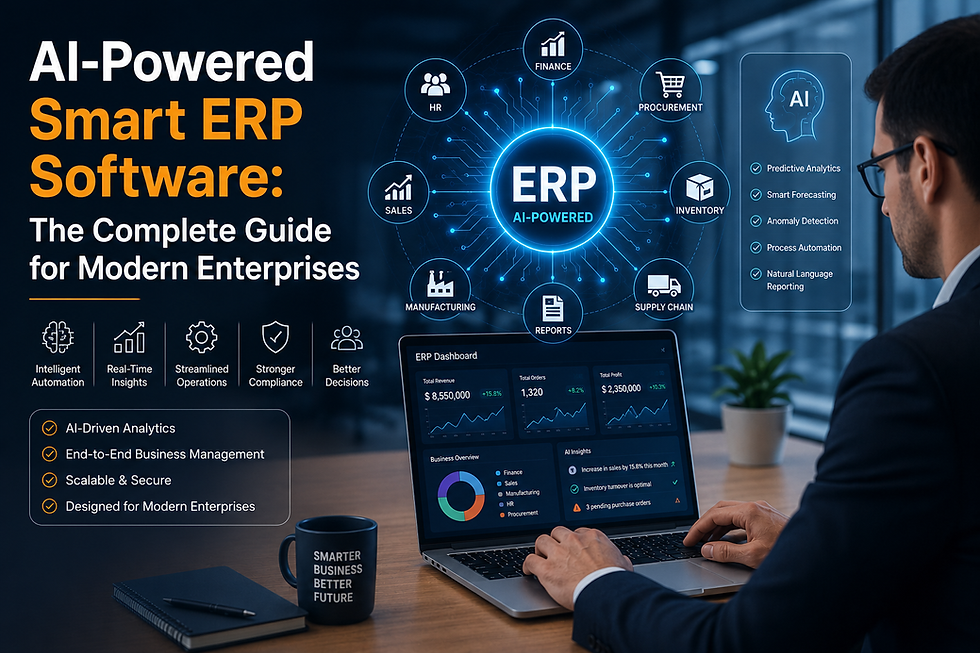
Artificial Intelligence (AI) is transforming how ERP software operates.
Modern ERP systems now automate repetitive tasks, analyze business data, and provide predictive insights that improve decision-making.
AI-powered ERP capabilities include:
Demand forecasting
Inventory optimization
Smart approvals
Financial forecasting
Procurement recommendations
Customer behavior analysis
Intelligent reporting
These capabilities reduce manual effort while improving operational accuracy.
3. Customized ERP Software Is Becoming Essential
Every organization has unique business processes.
Instead of adapting operations to standard software, businesses are increasingly investing in customized ERP software that aligns with their workflows.
Customization allows organizations to:
Create industry-specific workflows
Design personalized dashboards
Build custom reports
Configure approval processes
Improve user experience
Businesses achieve higher efficiency when the ERP system supports their exact operational requirements.
4. Growing Demand for Custom ERP Software Development
As industries become more specialized, organizations are choosing custom ERP software development to gain greater flexibility.
Custom ERP Software Development Services allow businesses to build solutions that integrate seamlessly with existing applications and support future growth.
Custom development often includes:
Third-party integrations
Industry-specific modules
Mobile applications
Advanced reporting
Workflow automation
API connectivity
This approach ensures the ERP platform evolves alongside business needs.
5. Mobile ERP for Anywhere Access
Today's workforce expects access to business systems from any location.
Mobile ERP applications allow employees to:
Approve requests
Monitor inventory
Review reports
Track projects
Access customer information
Manage procurement workflows
Mobile accessibility improves productivity, especially for remote and field teams.
6. Advanced Business Intelligence and Analytics
ERP software is increasingly focused on providing real-time insights.
Modern dashboards help businesses analyze:
Sales performance
Inventory levels
Procurement spending
Financial health
Employee productivity
Customer trends
Advanced analytics enable faster and more informed business decisions.
7. Greater Focus on Cybersecurity
As ERP systems store sensitive business data, security remains a top priority.
Modern ERP solutions now offer:
Multi-factor authentication
Role-based access control
Data encryption
Audit trails
Automated backups
Compliance management
Cloud ERP providers also invest heavily in enterprise-grade security infrastructure.
8. Seamless Integration Across Business Applications
Businesses no longer want isolated software systems.
Modern ERP platforms integrate with:
CRM software
HRMS
Payroll systems
Procurement platforms
E-commerce applications
Banking solutions
Business Intelligence tools
Integrated systems improve collaboration and eliminate duplicate data entry.
9. Industry-Specific ERP Solutions
Organizations increasingly prefer ERP platforms tailored to their industries.
Examples include:
Manufacturing ERP
Shop floor management
Quality control
Retail ERP
Inventory management
POS integration
Multi-store operations
Construction ERP
Project tracking
Equipment management
Budget control
Healthcare ERP
Patient records
Compliance
Resource planning
Industry-specific ERP improves operational efficiency and reduces implementation time.
10. Sustainability and ESG Reporting
Environmental, Social, and Governance (ESG) initiatives are becoming important for businesses worldwide.
Modern ERP software helps organizations:
Monitor energy consumption
Track carbon emissions
Reduce waste
Improve compliance reporting
Support sustainability goals
ERP systems are increasingly helping businesses achieve environmental objectives while improving operational efficiency.
Cloud ERP vs Traditional ERP
Feature | Cloud ERP | Traditional ERP |
Deployment | Cloud | Local Servers |
Initial Cost | Lower | Higher |
Maintenance | Vendor Managed | Internal IT Team |
Updates | Automatic | Manual |
Scalability | High | Limited |
Accessibility | Anywhere | Office Network |
Cloud ERP continues to lead because of its flexibility and lower operational costs.
How to Choose the Best ERP Software
When evaluating ERP solutions, businesses should consider:
Cloud deployment
Customization options
Industry expertise
AI capabilities
Integration support
Scalability
Mobile accessibility
Security features
Analytics
Vendor support
The best ERP software should not only meet current business needs but also support future growth.
Why Businesses Choose ZYNO ERP
ZYNO ERP is a modern, scalable platform designed to help organizations simplify operations and accelerate digital transformation.
Key Features
Cloud-based ERP software
Finance & Accounting
HR & Payroll
Procurement Management
Inventory Management
Manufacturing Management
Project Management
Workflow Automation
AI-powered Insights
Business Intelligence Dashboards
Secure Role-Based Access
Custom ERP Software Development Services
Whether you're looking for customized ERP software, custom ERP software development, or the best ERP software in India, ZYNO ERP offers a flexible solution that grows with your business.
Why ZYNO ERP Is Future-Ready
ZYNO ERP combines cloud technology, automation, AI-powered capabilities, and customizable workflows into one integrated platform. It enables businesses to improve collaboration, automate routine tasks, optimize procurement, manage finances, and gain real-time visibility across all operations.
With continuous innovation and scalable architecture, ZYNO ERP helps organizations stay ahead of evolving market demands.
Conclusion
ERP technology is advancing rapidly, with trends like cloud adoption, AI-powered automation, mobile accessibility, advanced analytics, and industry-specific customization shaping the future of business operations. Organizations that embrace these innovations can improve efficiency, reduce costs, and gain a competitive edge.
If you're looking for cloud based ERP software, customized ERP software, Custom ERP Software Development Services, or the best ERP software in India, ZYNO ERP provides a future-ready platform that helps businesses streamline operations, drive innovation, and achieve sustainable growth.
Comments