
AI-Powered Smart ERP Software: The Complete Guide for Modern Enterprises

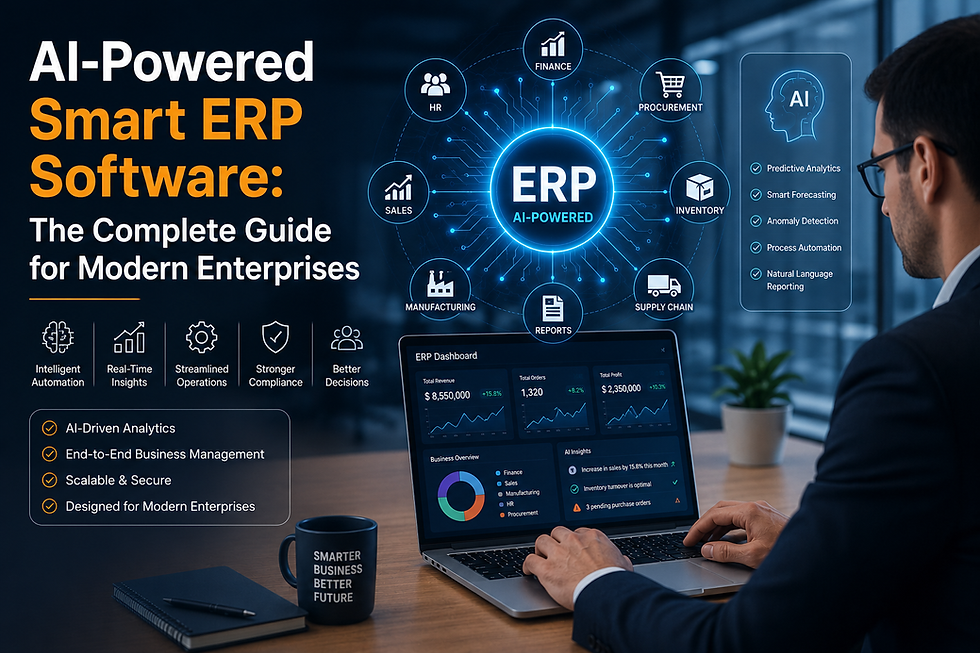
Businesses no longer struggle because they lack data. They struggle because they cannot act on it quickly enough.
Finance teams spend hours preparing reports. Procurement teams chase approvals through emails. Operations managers work across multiple disconnected systems. Leadership waits days for insights that should take minutes.
This is exactly where AI-powered smart ERP software changes the way organizations operate.
Instead of manually searching dashboards or exporting spreadsheets, users simply ask questions in natural language. The system understands the request, retrieves data instantly, automates workflows, and delivers meaningful insights without technical expertise.
Whether you're a growing enterprise or a multinational organization, AI in ERP is becoming a competitive advantage rather than an optional feature.
In this guide, you'll learn what AI-powered ERP is, how it works, why organizations are adopting it, and how platforms like ZYNO ERP are making intelligent enterprise software accessible across industries.
What is AI-Powered Smart ERP Software?
AI-powered smart ERP software is an enterprise resource planning system enhanced with artificial intelligence that automates business processes, understands natural language, predicts outcomes, and provides real-time business intelligence.
Unlike traditional ERP systems that require users to navigate multiple menus and reports, AI-enabled ERP allows employees to interact with the system naturally.
Instead of clicking through dozens of screens, users can simply ask:
Show pending purchase orders.
Generate last month's sales report.
Which vendors delivered late this quarter?
What products need replenishment?
The ERP processes the request and delivers the answer within seconds.
Featured Snippet
cis an enterprise management solution that combines traditional ERP capabilities with artificial intelligence to automate workflows, generate reports through prompts, improve forecasting, and help organizations make faster business decisions.
Why AI in ERP Matters
Traditional ERP systems successfully centralize business operations.However, they still depend heavily on manual effort.Employees often spend significant time:
Searching reports
Exporting Excel files
Preparing dashboards
Following approval chains
Tracking inventory manually
Responding to repetitive business queries
Artificial intelligence removes these bottlenecks
Rather than replacing ERP, AI makes ERP significantly smarter.
Organizations using AI Based ERP software can:
Reduce manual reporting
Improve operational visibility
Accelerate approvals
Detect anomalies earlier
Forecast demand accurately
Improve customer service
Increase employee productivity
The result is faster decisions backed by real-time enterprise data.
Core Capabilities of AI-Powered Smart ERP Software
Smart ERP Assistant
One of the biggest innovations in intelligent ERP systems is the Smart ERP Assistant.
Instead of navigating complex menus, users interact with ERP using conversational language.
Examples include:
Show today's pending approvals.
Display inventory below minimum stock.
Generate GST report for June.
Which suppliers have delayed deliveries?
The assistant understands intent and instantly retrieves relevant information.
This dramatically improves user experience while reducing dependency on technical teams.
Report Generation Through Prompts
Reporting remains one of the most time-consuming activities inside organizations.
Finance, HR, Procurement, and Operations teams often wait hours or even days for customized reports.
Modern ERP platforms now enable Report Generation through Prompts
Users simply type what they need.
Examples include:
Monthly purchase summary
Vendor payment aging
Employee attendance report
Sales comparison by region
Inventory valuation report
Reports are generated instantly without SQL queries or manual filtering.
This significantly reduces reporting time while improving data accessibility across departments.
AI Workflow Automation
Routine business processes consume thousands of employee hours every year.
AI Workflow Automation enables ERP systems to automate repetitive activities such as:
Purchase approvals
Leave approvals
Invoice processing
Vendor onboarding
Expense approvals
Asset allocation
Employee onboarding
Compliance reminders
Automation reduces human intervention while maintaining governance and compliance.
Predictive Business Intelligence
Modern ERP systems no longer report only historical data.
Artificial intelligence enables predictive insights such as:
Demand forecasting
Cash flow prediction
Inventory optimization
Employee attrition risk
Procurement spend analysis
Sales forecasting
Decision-makers receive recommendations before problems occur rather than after.
Multi-Language ERP Experience
Global businesses often operate across multiple countries
Language barriers frequently slow adoption
Modern ERP platforms can now provide insights in local languages, making technology accessible for a wider workforce.
This significantly improves employee adoption and usability across multinational organizations.
AI-Powered ERP vs Traditional ERP
Feature | Traditional ERP | AI-Powered Smart ERP Software |
Reporting | Manual | Prompt-based |
Search | Menu-driven | Natural language |
Workflow | Rule-based | Intelligent automation |
Forecasting | Historical | Predictive |
Dashboards | Static | AI-generated insights |
User Experience | Complex | Conversational |
Decision Making | Reactive | Proactive |
Productivity | Moderate | High |
Business Benefits of AI-Powered Smart ERP Software
Organizations investing in AI-powered smart ERP software experience measurable improvements across business functions.
Faster Decision Making
Executives receive real-time insights instead of waiting for manually prepared reports.
Improved Productivity
Employees spend less time performing repetitive administrative tasks.
Better Data Accuracy
Automation minimizes manual data entry and reduces human errors.
Intelligent Reporting
Users generate reports instantly using simple prompts.
Higher Employee Adoption
Conversational interfaces reduce training requirements and improve ERP adoption.
Operational Visibility
Leadership gains a unified view of finance, procurement, inventory, HR, manufacturing, CRM, and operations.
Industry Use Cases
Manufacturing
Manufacturers use AI-powered ERP to optimize production schedules, monitor inventory levels, predict equipment maintenance, and improve procurement planning.
Procurement
Procurement teams automate RFQs, purchase orders, supplier evaluations, spend analysis, and approvals through intelligent workflows.
Retail
Retail businesses improve stock planning, customer insights, sales forecasting, and omnichannel operations.
Healthcare
Hospitals streamline patient administration, inventory management, pharmacy operations, billing, and compliance.
Construction
Construction companies manage projects, procurement, inventory, contractor payments, and financial planning through integrated ERP systems.
How YNO ERP Brings AI Into Enterprise Operations
One example of AI-powered enterprise software is ZYNO ERP, which combines intelligent automation with enterprise resource planning.
Instead of requiring organizations to replace their existing systems, ZYNO AI can also integrate with existing ERP platforms to add intelligent capabilities.
Smart ERP Assistant
The Smart ERP Assistant enables users to interact with ERP using conversational language.
Examples include:
Show today's purchase requests.
Generate vendor aging report.
Display pending invoices.
Which projects exceeded budget?
The assistant understands context and returns accurate results instantly.
Report Generation Through Prompts
One of the most valuable capabilities inside ZYNO ERP is prompt-based reporting.
Business users simply describe the report they need.
Examples:
Monthly procurement spend
Employee attendance summary
Outstanding receivables
Inventory valuation
Sales by region
Reports are generated instantly without requiring technical expertise.
Multi-Language AI
Global organizations often operate across multiple regions.
ZYNO ERP supports multiple languages, allowing employees to receive reports and insights in their preferred language.
This improves collaboration while increasing ERP adoption.
AI Layer for Existing ERP Systems
Many organizations hesitate to adopt AI because replacing ERP is expensive
ZYNO AI addresses this challenge by acting as an intelligent AI layer over existing ERP systems.
Organizations continue using their current ERP while adding:
Smart ERP Assistant
AI Workflow Automation
Prompt-based reporting
Intelligent search
AI-powered insights
This approach reduces implementation risk while accelerating AI adoption.
Steps to Implement AI ERP Successfully
Successful AI ERP implementation begins with clear business objectives.
Follow these steps:
Assess current business processes.
Identify repetitive manual activities.
Prioritize automation opportunities.
Integrate AI with existing ERP systems.
Train employees.
Monitor adoption.
Continuously optimize workflows.
Organizations that implement AI gradually often achieve higher adoption rates and faster ROI.
How to Choose the Best AI-Based ERP Software
Before selecting an ERP platform, evaluate:
AI capabilities
Prompt-based reporting
Workflow automation
Integration with existing ERP
Scalability
Security
Industry-specific modules
Multi-language support
Mobile accessibility
Vendor expertise
Analytics capabilities
Customer support
The right ERP should simplify operations rather than introduce additional complexity.
Conclusion
Enterprise software is entering a new era where employees no longer need to adapt to complex systems. Instead, intelligent systems adapt to the way people work.
AI-powered smart ERP software enables organizations to automate workflows, generate reports through prompts, improve decision-making, and simplify enterprise operations through intelligent automation.
Whether you are implementing a new ERP platform or modernizing an existing one, AI provides an opportunity to improve productivity without increasing complexity.
Solutions like ZYNO ERP demonstrate how organizations can combine AI Workflow Automation, Smart ERP Assistant, Report Generation through Prompts, and multi-language support to build a more responsive, efficient, and future-ready enterprise.
The future of ERP is not about adding more features. It is about making enterprise software easier to use, faster to understand, and smarter in every decision.
Frequently Asked Questions
What is AI-powered smart ERP software?
It is an ERP system enhanced with artificial intelligence that automates workflows, generates reports, and provides intelligent business insights.
Can AI work with my existing ERP?
Yes. Modern platforms such as ZYNO AI can integrate with existing ERP systems without requiring a complete replacement.
What is a Smart ERP Assistant?
A Smart ERP Assistant allows users to interact with ERP using natural language instead of navigating menus and reports.
How does Report Generation through Prompts work?
Users simply type the report they need. The ERP understands the request and generates reports instantly.
Which industries benefit from AI ERP?
Manufacturing, healthcare, construction, retail, logistics, education, procurement, finance, and government organizations all benefit from AI-enabled ERP solutions.

Comments